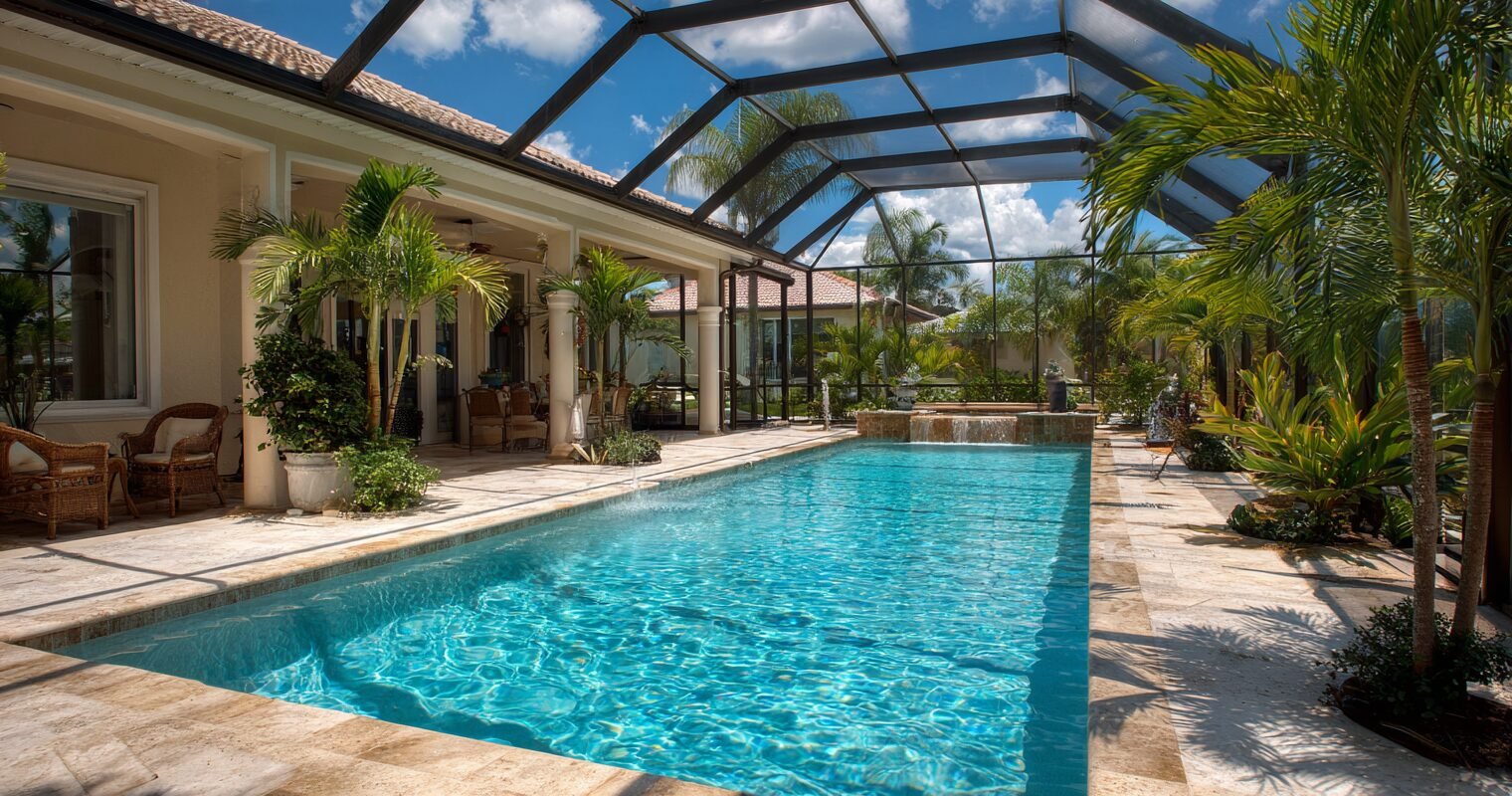
Short answer: for most families, 14×28 to 16×32 feet. A 16×32 pool (512 sq ft) comfortably handles a family of four to six with room for games, floats, and a few guests — which is why it’s the single most quoted size in the industry. Couples and small yards do well at 12×24; households that entertain heavily lean toward 18×36 or larger.
Size is also the biggest cost lever you control, because pools are priced primarily by water surface area. Here’s how to pick the right one without overbuying.
Pool Size by Household
| Size | Area | Best for |
|---|---|---|
| 10×20 – 12×24 | 200–288 sq ft | Couples, small yards, plunge-style cooling off |
| 14×28 | 392 sq ft | Family of 3–4, moderate entertaining |
| 16×32 | 512 sq ft | Family of 4–6 — the industry standard |
| 18×36 | 648 sq ft | Frequent entertaining, older kids, real lap swimming |
| 20×40+ | 800+ sq ft | Large households, estate lots, serious swimmers |
Price any of these for your state in the pool cost calculator — the slider makes the cost difference between 14×28 and 18×36 immediately obvious.
Start With Your Buildable Area, Not Your Wish List
Your yard is smaller than it looks. Subtract setbacks (commonly 5–10 feet from property lines, structures, and septic fields), utility easements, and a path wide enough for excavation equipment. A 40×30 backyard often nets a buildable window closer to 28×18 — which caps your pool near 14×28 once you allow for decking.
Two rules of thumb: leave at least 3–4 feet of deck on all sides (4–6 on the entry side), and try to keep the pool under 25% of usable yard area so you don’t trade your lawn entirely. Our permits guide covers how to confirm setbacks before you design.
How Deep Should It Be?
The industry has moved decisively toward shallower pools, and for good reason. A 3.5-to-5-foot uniform depth or a gentle 3.5-to-6-foot slope matches how families actually use water: standing, floating, playing. It also costs less to build, heat, and chemically balance than a deep pool.
Diving requires 8–9 feet minimum plus specific length and slope geometry — and brings real liability and insurance considerations. Most builders will tell you privately that diving boards are a shrinking category for exactly these reasons.
Bigger Isn’t Proportionally More Expensive — Or Cheaper
This surprises people in both directions. Fixed costs — mobilization, permits, equipment, electrical — don’t scale with size, so a 12×24 typically costs 65–75% of a 16×32, not half. Going smaller saves less than you’d expect.
But going bigger compounds beyond construction: more water to heat, more chemicals, more surface to clean, and more decking around a larger perimeter. The operating-cost gap between a 12×24 and a 20×40 runs hundreds of dollars a year, every year. See our breakdown of monthly maintenance costs.
Shape Changes Effective Size
Two pools with identical bounding dimensions can differ 40% in water area. A rectangle fills its footprint completely; an oval holds about 79%; a kidney only 60–65%. That’s why a kidney “reads” larger than it prices — a useful trick for modest budgets that want a lush look. Our pool shapes guide covers the tradeoffs, and the calculator adjusts area by shape automatically.
The Sizing Mistakes Worth Avoiding
- Sizing for your peak party, not your Tuesday. You’ll swim with your household hundreds of times and host twenty people twice a year. Build for the former.
- Forgetting the deck in the footprint. A 16×32 pool with proper decking occupies roughly 24×40 of yard.
- Adding depth “just in case.” Deep ends raise cost, heating, and chemical volume for a feature most families use rarely.
- Maxing the lot. The most-regretted layouts are the ones that left no lawn.
Frequently Asked Questions
What is the most popular pool size?
16×32 feet — 512 square feet of water. It fits a family of four to six comfortably, suits most suburban lots, and is the size most builders quote by default.
What size pool is best for a family of four?
14×28 to 16×32 is the sweet spot. That gives everyone room to swim and play without paying to build, heat, and maintain water you rarely use.
How much deck space do you need around a pool?
At least 3–4 feet on all sides for safe circulation, and 6–10 feet on the side where you’ll place chairs and tables. Total decking typically covers two to four times the pool’s own footprint.
Is a smaller pool much cheaper?
Less than you’d expect on construction — a 12×24 typically runs 65–75% of a 16×32 because permits, equipment, and mobilization are fixed. But smaller pools are meaningfully cheaper to run, since heating and chemicals scale with water volume.