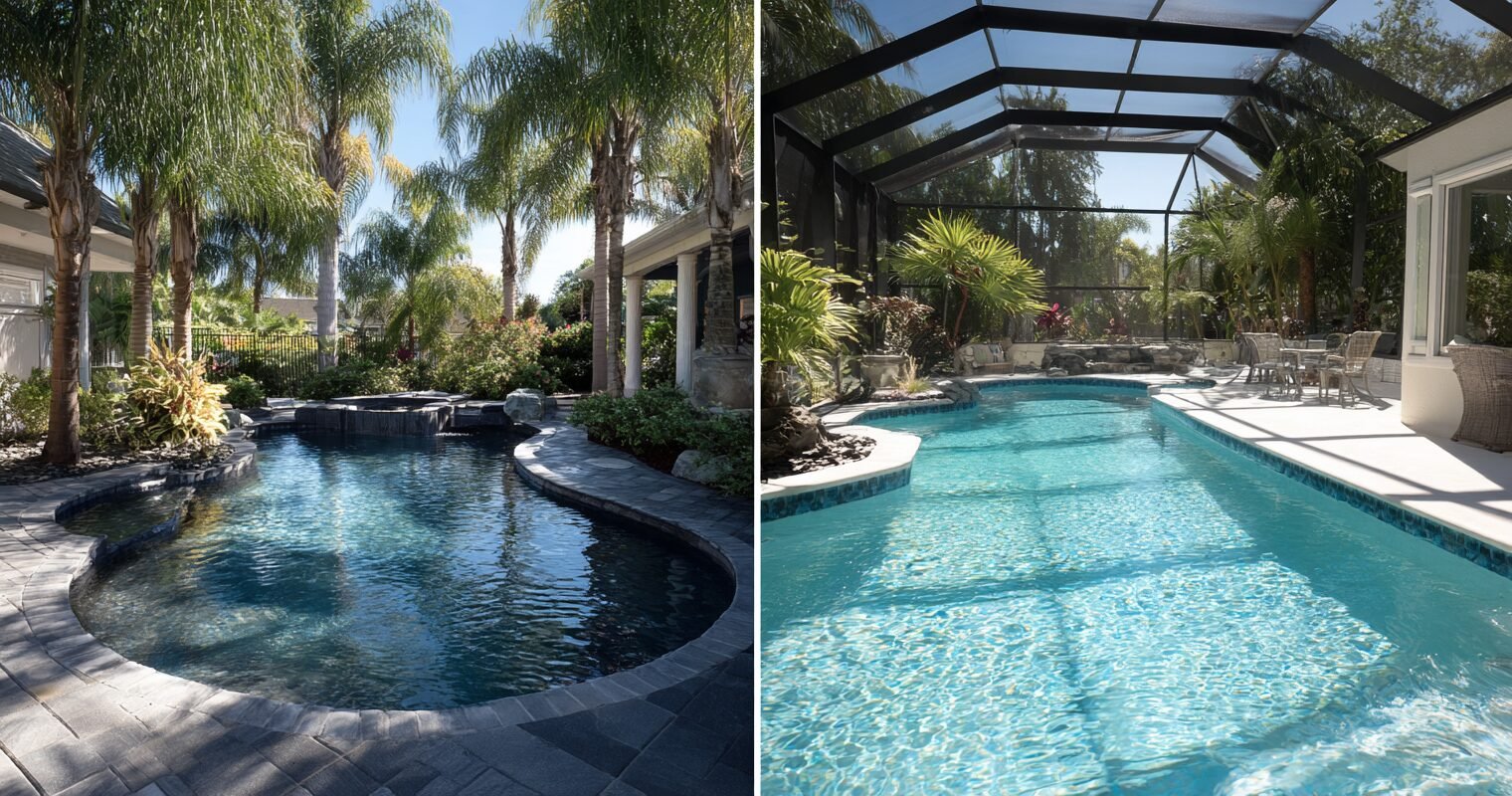
The single biggest decision you’ll make about your pool isn’t the shape or the tile — it’s the construction type. It determines your budget, your timeline, your maintenance costs for the next 25 years, and even which shapes are possible. Here’s how the options actually compare.
Inground vs. Above Ground
Above-ground pools run roughly $1,500–$16,000 installed and can be removed when you move — but they add little to no home value, last 7–15 years, and limit you to round or oval shapes. Inground pools cost $35,000–$120,000+ but last decades, integrate with your landscaping, and (in warm climates especially) add real resale appeal. If you’re on this site planning layouts on satellite imagery, you’re almost certainly shopping inground — so that’s what the rest of this guide covers.
Fiberglass Pools
A fiberglass pool is a one-piece shell, molded in a factory and delivered to your yard on a truck. The builder excavates, sets the shell, plumbs it, and backfills — which is why fiberglass has the fastest installs in the industry: 3–6 weeks is typical, and the shell itself is often in the ground within days.
- Cost: roughly $50–$100 per square foot installed ($45,000–$85,000 for most projects)
- Lifespan: 25–30 years, with no liner replacements or resurfacing on a normal schedule
- Maintenance: the smooth gelcoat surface resists algae, so chemical costs are the lowest of the three types — figure $1,200–$2,000 per year
- The catch: you’re limited to the manufacturer’s catalog of shapes and sizes, and shells max out around 16 feet wide because they travel by road
Gunite / Concrete Pools
Gunite (sprayed concrete over a rebar frame) is the fully custom option. Any shape, any depth, any size — vanishing edges, tanning ledges, beach entries, integrated spas. This is the pool you see in magazine spreads, and it’s built to outlive the house: 50+ years for the structure.
- Cost: roughly $75–$150 per square foot installed ($60,000–$120,000+ is the realistic range in most markets)
- Timeline: 8–16 weeks — concrete needs to be sprayed, cured, plastered, and filled on a schedule you can’t rush
- Maintenance: the highest of the three. Plaster is slightly porous, which invites algae; expect $2,500–$4,500 per year in chemicals and upkeep, plus resurfacing every 10–15 years at $10,000+
- The catch: beyond price, concrete pools in freeze-thaw climates need careful engineering, and the long build ties up your yard for a season
Vinyl Liner Pools
A vinyl pool is a framed structure (steel, polymer, or concrete walls) with a custom-fit vinyl liner. It’s the cheapest way to get an inground pool, and modern liners look far better than the ones from decades past.
- Cost: roughly $35–$80 per square foot installed ($35,000–$65,000 typical)
- Timeline: 4–8 weeks
- Maintenance: $1,500–$2,500 per year — but budget for the big one: liners last 5–9 years and cost $3,000–$7,000 to replace
- The catch: over a 25-year ownership window, three liner replacements can erase most of the upfront savings versus fiberglass
Which Type Should You Choose?
Choose fiberglass if you want the best long-term cost of ownership, a fast build, and a standard shape works for your yard. Choose gunite if you want a custom shape or size, plan to stay in the home long-term, and the maintenance budget doesn’t scare you. Choose vinyl if upfront budget is the constraint and you’re comfortable with the liner replacement cycle.
The best way to compare them for your budget: run the same pool size through our free pool cost calculator and switch between the three types — you’ll see the cost difference instantly, priced for your state.
Frequently Asked Questions
Which pool type adds the most home value?
In warm-climate markets, a well-maintained gunite pool generally adds the most perceived value because buyers read it as “permanent.” But real-estate data consistently shows you recoup only a fraction of any pool’s cost at sale — build a pool because you’ll use it, not as an investment.
Can I convert a vinyl pool to fiberglass or gunite later?
Conversions exist but usually cost nearly as much as building new, because the existing structure rarely matches the new shell’s requirements. If you’re torn between types, it’s cheaper to stretch the budget once than to convert later.
Do fiberglass pools pop out of the ground?
It can happen — but only when a pool is drained in an area with a high water table, which is an installation and maintenance error, not a product flaw. A properly installed shell that stays full is stable for decades.