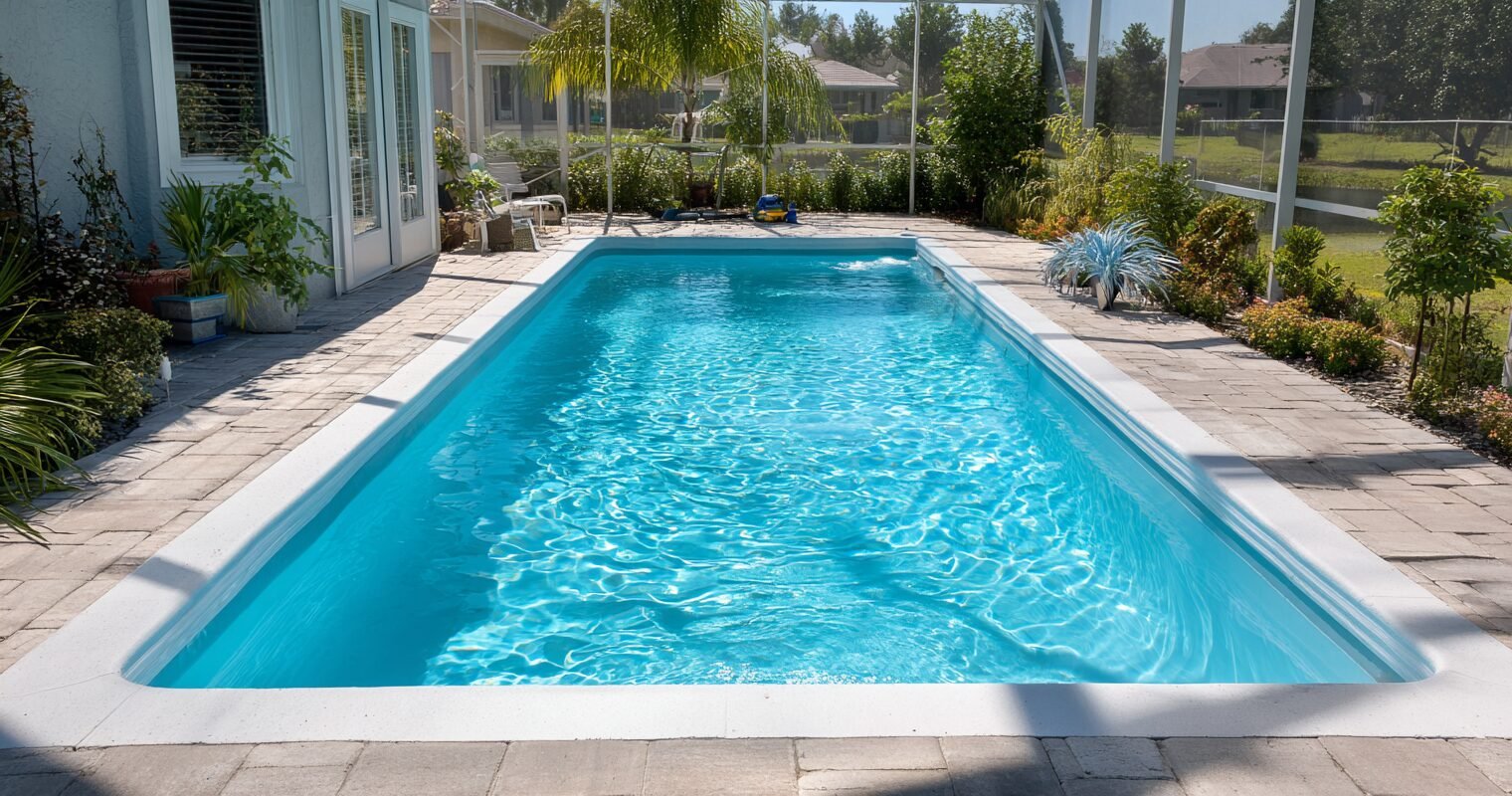
Short answer: fiberglass is cheaper, faster, and far cheaper to own; concrete (gunite) is fully custom and lasts longer. A fiberglass pool typically costs $45,000–$85,000 installed and is swimmable in 3–6 weeks. A gunite pool runs $60,000–$120,000+ and takes 8–16 weeks. Over 25 years, a gunite pool usually costs $40,000–$100,000 more to own once you add maintenance and resurfacing. Pick fiberglass if a catalog shape fits your yard. Pick concrete if it doesn’t.
Both are excellent pools, and the right one depends on which trade-offs you can live with. Here’s the head-to-head, category by category, with numbers instead of adjectives.
Fiberglass vs. Concrete at a Glance
| Fiberglass | Concrete (gunite) | |
|---|---|---|
| Installed cost | $45,000–$85,000 | $60,000–$120,000+ |
| Cost per sq ft | $50–$100 | $75–$150 |
| Annual upkeep | $1,200–$2,000 | $2,500–$4,500 |
| Big recurring cost | None on a normal schedule | Resurfacing every 10–15 years, $10,000+ |
| Build time | 3–6 weeks | 8–16 weeks |
| Structure lifespan | 25–30+ years | 50+ years |
| Shapes and sizes | Manufacturer catalog, max ~16 ft wide | Anything you can pay for |
| Surface feel | Smooth gelcoat | Plaster or pebble, slightly textured |
| Est. 25-year total | ~$75,000–$135,000 | ~$140,000–$260,000 |
The 25-year totals are installed cost plus 25 years of typical upkeep, plus two gunite resurfacings. They exclude decking, fencing, heaters, and landscaping, which cost roughly the same for either type. Your region moves every number here, so treat them as a starting point, not a quote.
Upfront Cost: Fiberglass Wins
Fiberglass installs run roughly $50–$100 per square foot; gunite runs $75–$150. On a 450-square-foot pool, that’s a typical gap of $15,000–$25,000 in fiberglass’s favor. Concrete quotes also carry more variance — complex shapes, custom depths, and long cure schedules give the price more places to grow.
One caveat: fiberglass shells travel by truck and are set by crane. If your backyard needs a very large crane or has no route for one, delivery can add several thousand dollars and narrow that gap. Ask for crane and delivery costs in writing before you compare bids.
Lifetime Cost: Fiberglass Wins Bigger
The gap widens after the build. A gunite pool needs $2,500–$4,500 a year in chemicals and upkeep, plus a $10,000+ resurfacing every 10–15 years. Fiberglass needs $1,200–$2,000 a year and no scheduled resurfacing. Over 25 years, total ownership cost typically favors fiberglass by $40,000 or more. If the spreadsheet is making your decision, it’s already made.
Why the difference? Plaster is slightly porous, so algae has somewhere to grip, and plaster chemistry pushes pH up constantly. That means more acid, more chlorine, and more brushing. Gelcoat is non-porous, so the same water stays balanced with less effort. Our breakdown of pool maintenance cost per month shows where that money goes line by line.
Design Freedom: Concrete Wins, and It’s Not Close
Fiberglass shells come from a catalog — excellent catalogs these days, but catalogs, capped around 16 feet wide and 40 feet long by road-transport rules. Gunite is limited only by budget and physics: vanishing edges, beach entries, 12-foot diving wells, integrated spas, freeform lagoons. If your vision doesn’t exist in a shell manufacturer’s brochure, concrete is your answer.
Oddly shaped lots also favor concrete. A gunite pool can follow a curved property line, wrap around a tree you want to keep, or squeeze into a narrow side yard. For smaller yards, our guide to pool shapes for small backyards shows which layouts work in either material.
Timeline: Fiberglass by a Mile
Fiberglass: 3–6 weeks, and the shell is often swimming-ready within days of arrival. Gunite: 8–16 weeks of excavation, steel, spraying, a multi-week cure, plaster, and startup chemistry. Sign a gunite contract in May and you may be swimming in September; sign fiberglass in May and you’re swimming in June. See how long it takes to build a pool for the full stage-by-stage schedule.
Durability: Both Win, Differently
A gunite structure lasts 50+ years — it’s the closest thing to permanent in residential construction, though its interior finish needs periodic renewal. A fiberglass shell is rated 25–30 years, resists ground movement better in expansive soils, and its gelcoat never needs replastering. In freeze-thaw climates both perform well when built correctly; fiberglass’s flexibility is a quiet advantage in shifting soils.
What actually fails? On gunite, it’s the surface: plaster etches, stains, and roughens until it needs resurfacing. On fiberglass, the most common late-life issue is gelcoat fading or fine surface cracking, which can be refinished. Structural failure is rare with either when a reputable builder does the work, which is why builder choice matters more than material choice. Our guide to choosing a pool builder covers what to check.
Climate and Soil
- Expansive clay soils (much of Texas, Oklahoma, and parts of the Southeast): fiberglass flexes slightly with ground movement; rigid concrete can crack if the engineering is skimped. Either works, but gunite needs a soils report and proper steel.
- Hot, sunny climates (Arizona, Florida, Southern California): long swim seasons mean more hours of pumping and chemicals, which magnifies fiberglass’s lower upkeep. Heavy UV also fades gelcoat faster, so ask about UV-resistant finishes.
- Freeze-thaw climates (the Midwest and Northeast): both hold up when properly winterized. Fiberglass’s shorter build time matters more here, because the building season is short.
- High water tables and coastal areas: any empty pool can lift out of the ground. Both types need hydrostatic relief valves, and you should never drain either one without professional advice.
Our state-by-state pool cost guides cover the regional factors that apply where you live.
Feel and Aesthetics
Gelcoat is smooth underfoot; pebble finishes have texture that some people love and some find abrasive. Concrete’s tile and finish options simply look more custom — because they are. But a fiberglass pool wrapped in good coping and travertine decking reads far more premium than the shell price suggests. Our materials guide covers how finish choices change the look and the bill.
Resale Value
Buyers rarely pay more for one material over the other. What they notice is condition: a gunite pool that’s due for resurfacing is a $10,000+ line item in the inspection report, while a clean fiberglass pool with no surface problems reads as low-hassle. A spectacular custom concrete pool can be a selling point in luxury markets. For most homes, though, a pool’s resale effect depends far more on your region and price bracket than on what it’s made of. Our analysis of whether pools add home value goes deeper.
What About Vinyl Liner?
Vinyl is the third option and the cheapest to install, at $35,000–$65,000. The catch is the liner, which lasts 5–9 years and costs $3,000–$7,000 to replace. Over 25 years, those replacements erase most of the savings versus fiberglass. Vinyl makes the most sense on a tight upfront budget or when you want a custom shape without paying gunite prices. Our pool types guide compares all three side by side.
Which Is Better for You?
Fiberglass is probably right if:
- a catalog shape and size fits your yard and your plans
- lowest ownership cost matters more than a one-of-a-kind design
- you want to be swimming this season
- you’d rather spend weekends swimming than brushing walls
Concrete is probably right if:
- you want a size, depth, or shape no manufacturer makes (over ~16 ft wide, a diving well, a vanishing edge)
- you plan to stay in the home for decades and want the most permanent structure
- you’re building in a high-end market where custom design is expected
- you’ve budgeted honestly for $2,500–$4,500 a year plus resurfacing
The Verdict
Buy fiberglass if a catalog shape fits your yard and you value speed and low ownership costs. Buy gunite if customization, size, or permanence tops your list and you’ve budgeted honestly for maintenance. Either way, price both in our free cost calculator — switching pool types takes one click, and seeing the numbers side by side for your region tends to settle the debate quickly.
Frequently Asked Questions
Is a fiberglass pool cheaper than concrete?
Yes, both upfront and over time. Fiberglass typically costs $45,000–$85,000 installed versus $60,000–$120,000+ for gunite, and it costs roughly half as much per year to maintain. Over 25 years the total gap is usually $40,000 or more.
Which lasts longer, fiberglass or concrete?
A concrete structure lasts 50+ years but needs resurfacing every 10–15 years. A fiberglass shell is rated for 25–30+ years and needs no scheduled resurfacing, though its gelcoat may eventually need refinishing.
Is fiberglass or concrete better in cold climates?
Both perform well in freeze-thaw climates when properly built and winterized. Fiberglass has a practical edge because it installs in 3–6 weeks, which fits into a short building season more easily than an 8–16 week gunite build.
Can a fiberglass pool be as big as a concrete pool?
No. Fiberglass shells ship by road, which limits them to about 16 feet wide and 40 feet long. If you want anything larger, a deep diving well, or a fully custom shape, concrete is the only option.
Do fiberglass pools crack?
Structural cracks are rare when a shell is installed correctly on a proper base. Fine surface cracks in the gelcoat can appear over time, especially with poor installation or heavy sun, and can be repaired or refinished.