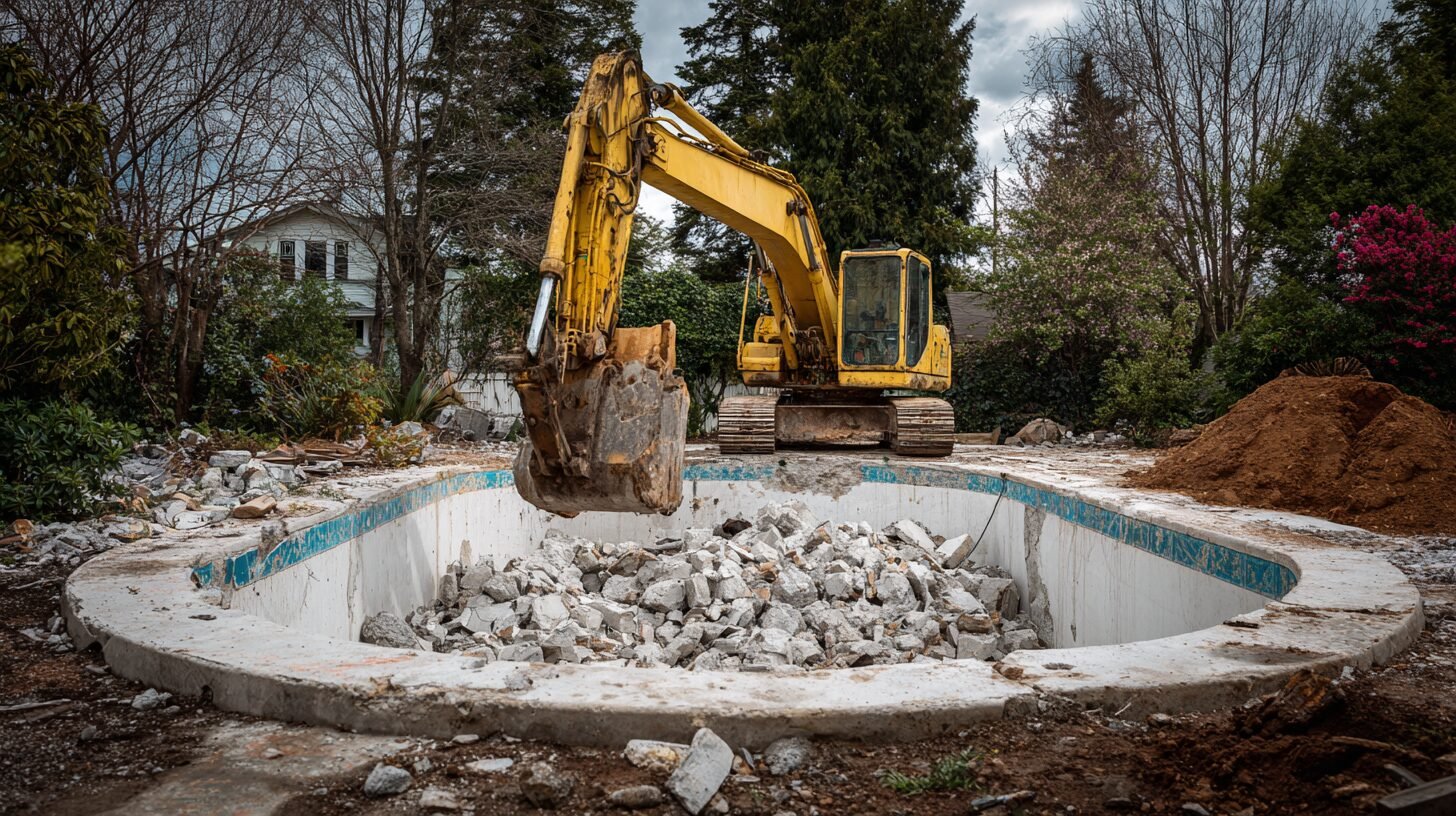
Short answer: $4,000 to $16,000, depending on the method. A partial fill-in — breaking up the bottom, collapsing the walls, and backfilling — typically runs $4,000–$9,000. A full removal, where the entire shell is demolished and hauled away, runs $9,000–$16,000+. The cheaper option costs you more later, and here’s exactly why.
Partial Fill-In vs. Full Removal
Partial fill-in ($4,000–$9,000). The contractor punches drainage holes in the pool floor, breaks the top 18–36 inches of wall, pushes that rubble into the hole, and backfills with soil. Fast — often two to three days — and the cheapest route.
The catch is permanent: buried concrete and fill soil settle unevenly for years, the area is generally not suitable to build on, and — critically — you must disclose it at resale. Many jurisdictions require the filled pool to be recorded on the property. Buyers and appraisers routinely discount for it.
Full removal ($9,000–$16,000+). The entire shell — floor, walls, plumbing, and rebar — is demolished and hauled off, then the hole is backfilled with engineered fill and compacted in lifts. More expensive and slower (three to seven days, plus disposal), but the yard returns to buildable land with no disclosure baggage and no long-term settling.
What Drives the Price
- Pool size and type. Gunite is the most expensive to demolish — it’s a reinforced concrete structure. Vinyl liner pools are cheapest, since the walls are steel or polymer panels. Fiberglass shells are cut apart and hauled in pieces.
- Access. This is the sleeper cost. If an excavator can’t reach the backyard, crews work with mini-equipment or by hand, which can double the labor bill. Narrow side yards and mature landscaping are the usual culprits.
- Disposal fees. Concrete and rubble hauling is priced by weight and varies enormously by metro.
- Fill material. Full removals need engineered fill and compaction testing, not just whatever dirt is nearby — often $1,500–$4,000 of the total.
- Permits. Yes, demolition needs permits too, typically $200–$800, plus inspections of the backfill. See our permits guide for how local processes work.
Should You Remove It or Fix It?
Before spending five figures to erase a pool, price the alternative. Many “unusable” pools need renovation, not removal:
- New vinyl liner: $3,000–$7,000
- Resurfacing gunite (replaster or pebble): $6,000–$15,000
- New pump and filter: $1,500–$4,000
- New heater: $1,500–$5,000
- Full equipment-and-surface refresh: often $10,000–$20,000 — comparable to full removal, and you end up with a working pool
If the shell is structurally sound and you’re in a market where pools help resale — see our take on whether pools add home value — renovation is usually the better financial move. Removal makes sense when the structure has failed, the yard is unusable, or you’re in a cold-climate market where the pool is actively deterring buyers.
The Resale Question
A filled-in pool is a known quantity in real estate, and buyers price it cautiously. Partial fill-ins raise questions about settling, drainage, and what’s actually buried back there. Full removals with documented engineered backfill and inspection records raise almost none — keep every permit, invoice, and compaction report, because that paperwork is what turns “there used to be a pool” from a red flag into a footnote.
Hiring the Job Out
Get three bids from demolition or excavation contractors — not landscapers — and make sure each bid specifies method (partial vs. full), fill material, compaction standard, disposal, permits, and final grading. The same vetting logic from our choosing a contractor guide applies: license, insurance certificates from the insurer, and references from recent comparable jobs.
Frequently Asked Questions
How much does it cost to fill in a pool?
$4,000–$9,000 for a partial fill-in and $9,000–$16,000+ for full removal. Gunite pools cost the most to demolish, vinyl liner the least, and difficult backyard access can push either figure substantially higher.
Do you have to disclose a filled-in pool?
In most states, yes — buried structures and fill are material facts, and many jurisdictions record the fill-in on the property. Full removals with documented engineered backfill carry far less resale friction than partial fill-ins.
Can you build on top of a filled-in pool?
Generally not after a partial fill-in — the ground isn’t engineered to support structures and settles for years. After a full removal with compacted engineered fill and inspection, the area can typically be built on, though local requirements vary.
Is it cheaper to fix a pool or remove it?
Often cheaper to fix. A new liner runs $3,000–$7,000 and resurfacing $6,000–$15,000, versus $9,000–$16,000+ for full removal. If the shell is structurally sound, renovation usually wins financially — and you end up with a usable pool.