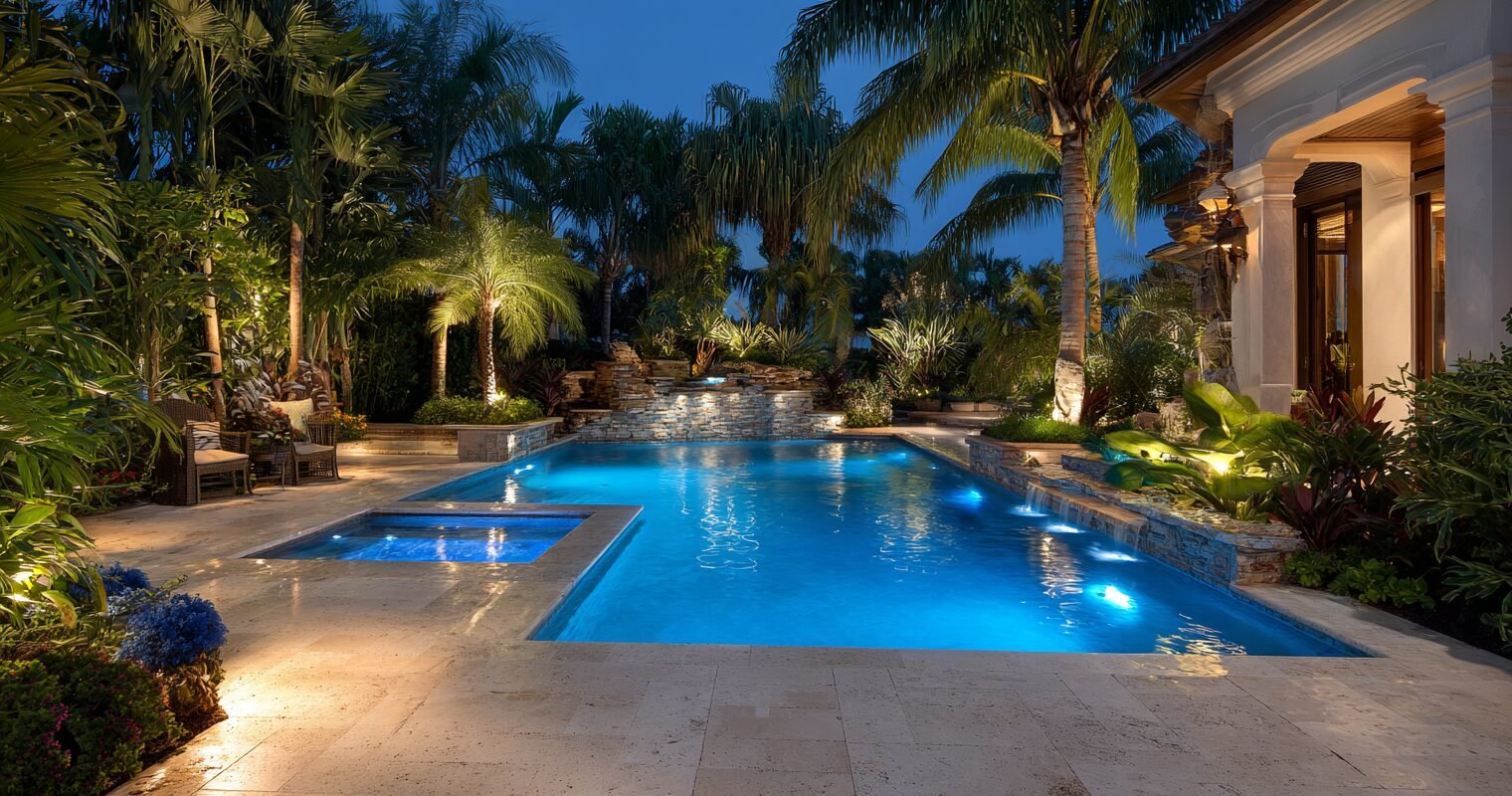
Pool shape is where budget meets personality. The shape you choose changes your pool’s cost, how it fits your yard, what it’s like to swim in, and even your fencing and decking bills. Here’s an honest look at the popular shapes — including the ones builders quietly wish you’d skip.
Rectangle: The Workhorse
The classic for a reason. Rectangles maximize swimmable area for their footprint, suit lap swimming, pair naturally with modern architecture, and make automatic covers cheap and easy — a rectangle is the only shape a standard track-mounted auto cover fits without custom work. A 16×32 rectangle (512 sq ft) is the most quoted size in the industry. If you want a pool that does everything competently, start here.
Oval & Roman: Softer Classics
An oval keeps most of a rectangle’s swim lane but rounds the ends, which reads softer in a traditional landscape. Roman and Grecian variants square the sides and detail the corners. You give up roughly 20% of the surface area versus a rectangle of the same length and width, which slightly lowers construction cost — surface area is the biggest cost driver in pool pricing.
Kidney: The Natural Look
The kidney’s curved, indented profile was designed in the 1940s to make pools feel like ponds, and it still does that job beautifully. The indent is a natural spot for planting, a rock feature, or a spa. Kidneys yield about 60–65% of their bounding rectangle in water area, so they price out smaller than they look — a good trick for modest budgets that want a lush result. They’re a poor fit for lap swimmers and auto covers.
L-Shape & Lazy-L: Zoned Swimming
The L family puts a shallow play leg at an angle to a deeper swim lane — which is really a way of buying two pools in one. Families with young kids love the separation: the short leg stays shallow for play, the long leg stays clear for swimming. The extra perimeter adds cost per square foot of water, and the inside corner needs thoughtful deck design, but for mixed-age households it’s the most functional shape on this list.
Freeform: Anything Goes (For a Price)
Freeform pools follow no template — lagoon curves, island steps, grottos. They demand gunite construction (fiberglass shells only come in catalog shapes), and complexity is the enemy of budget: more perimeter means more coping, more tile, more formwork, more labor. If you’re drawn to freeform, get the shape sketched early and priced as a line item so you know what the curves are costing you.
How Shape Changes Cost
Two rules explain most of it. Rule one: you pay for water area. A shape that fills less of its bounding box costs less to build at the same overall footprint. Rule two: you also pay for perimeter. Coping, tile, and formwork are priced by the linear foot, so wiggly outlines cost more per square foot of water than clean ones. A kidney scores well on both rules; an elaborate freeform scores badly on rule two.
Matching Shape to Yard
- Long, narrow yard: rectangle or lazy-L along the fence line
- Wide, shallow yard: oval or kidney set broadside to the house
- Small yard (under ~1,000 usable sq ft): a compact 12×24 rectangle or plunge-style kidney — see our post on pools for small backyards
- Sloped or irregular yard: freeform or kidney, which absorb odd boundaries gracefully
Once a shape is on your shortlist, price it: our free pool cost calculator adjusts water area for each shape automatically, so you can compare a 32-foot rectangle against a kidney or L-shape of the same footprint and see the cost difference for your state in seconds.